


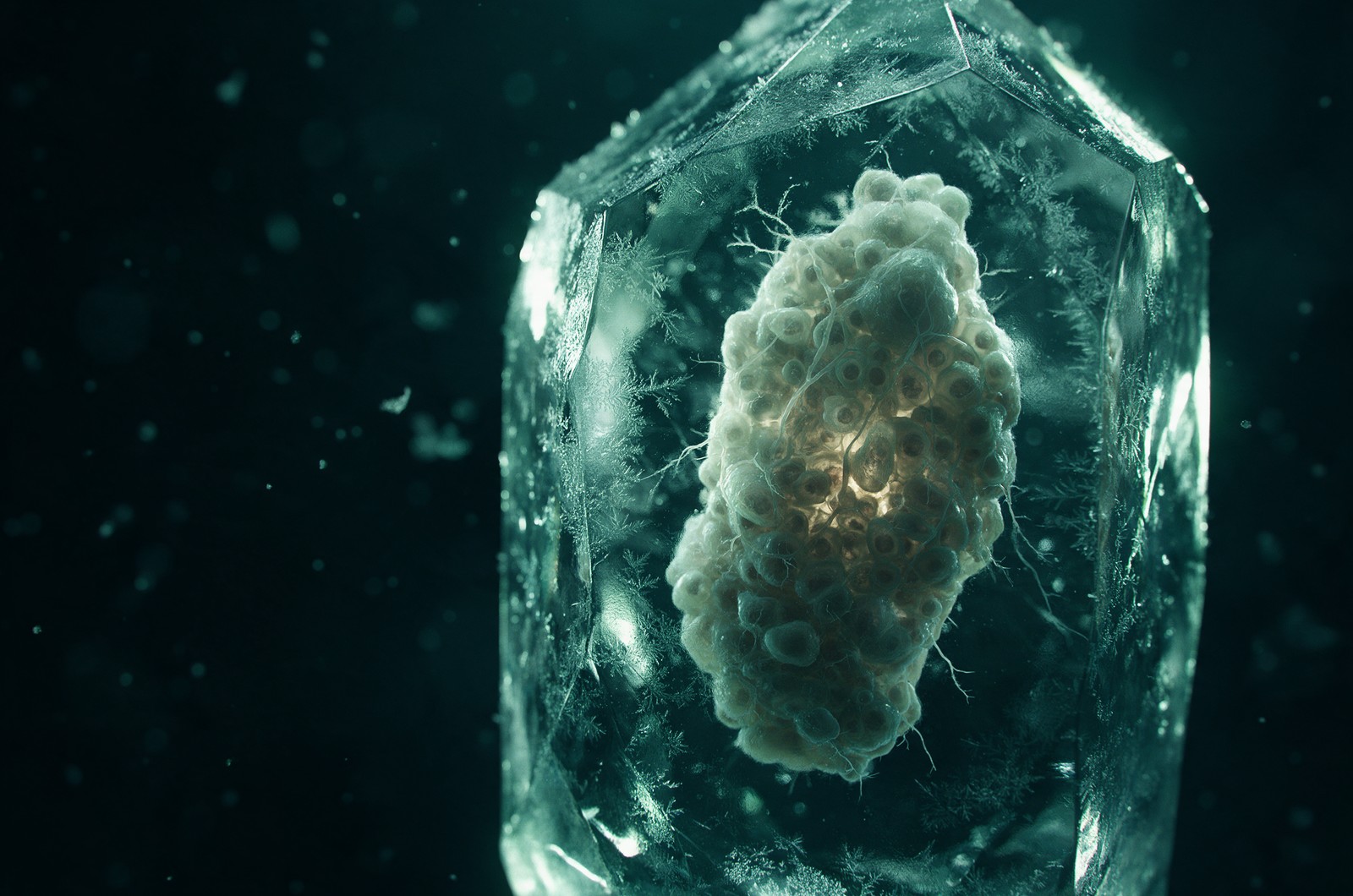


An oncology biobank collects tumour tissue, matched normal tissue, blood and derived analytes from cancer patients and stores them under defined procedures for research and diagnostics, alongside clinical data and consent records. Unlike many other collections, much of its inventory can never be replaced. A pre-treatment biopsy exists exactly once — and it carries highly sensitive health and genetic data.
Biobank security therefore has to work on three axes at once: sample integrity, controlled, traceable access and data protection. A storage concept that covers only one of them falls short for a tumour biobank.
A tumour sample is often irreplaceable because it captures a biological state that cannot be recreated: one point in the disease course, an untreated tumour, a rare entity or a complete matched set from one patient. Once lost, it has no equivalent substitute — not even from the same patient.
The security level of a tumour biobank should therefore be set by the replacement value of the individual sample, not by storage volume — and for much of the inventory, that value is incalculable.
A tumour sample's integrity is decided in two places: before freezing, in the pre-analytical phase, and afterwards, through an unbroken temperature history. Storage technology can only protect the second — but it must always be able to prove that it has.
Molecular analytes are sensitive to ischaemia time — the interval between interruption of the blood supply and stabilisation of the tissue. RNA expression profiles and phosphoproteins in particular can change measurably within it. Dedicated standard series address tissue pre-analytics, such as ISO 20184 for frozen tissue and ISO 20166 for formalin-fixed, paraffin-embedded tissue.
Ischaemia times and processing steps therefore belong in every sample's metadata. No storage system can rescue a sample that sat unchilled for too long before freezing.
Many tissue banks store at –80 °C, and for short- to medium-term storage that is established practice and often sufficient. The case for liquid nitrogen concerns inventories kept for decades and accessed regularly.
At –80 °C a sample sits above the glass transition temperature of roughly –130 °C, where recrystallisation and slow degradation continue. Over short periods the effect is often negligible; over decades it is not.
Cryogenic biospecimen storage in the vapour phase above liquid nitrogen keeps samples below that threshold, provided tank, loading and fill level are correctly specified — which temperature mapping during qualification verifies. It also removes direct contact with liquid nitrogen as a contamination route. And in a power failure a compressor-based freezer stops at once, while a cryogenic tank holds for hours to days.
A high-security oncology biobank protects its samples on five layers: physical, procedural, technical, data protection and redundancy. A perfectly monitored tank in an unrestricted room is as much a weakness as a locked room with no temperature record.
ISO 20387 requires, among other things, traceability of biological material and associated data, as well as controlled storage conditions. The procedural layer puts that requirement into daily practice.
Under Article 9 of the GDPR, health and genetic data are special categories of personal data. Samples are therefore pseudonymised, with the re-identification key held separately and accessible only to authorised staff. Pseudonymised data still counts as personal data.
Every sample also carries its consent status. If a donor withdraws consent, the biobank must reliably locate the affected samples and data and, depending on the consent terms, destroy or anonymise them. That only works if storage position and consent are firmly linked in the inventory. The cryogenic infrastructure itself never needs to know identities — container and position data are enough.
For the most valuable cases — treatment-naive biopsies, rare entities, complete matched sets — split aliquots across two tanks, ideally at two sites. No single event should be able to reach a case's entire holding.
Not every sample needs this tier. Material that is plentiful or can be collected again can be stored more simply. Classifying samples by irreplaceability puts the effort where it genuinely protects them.
Opening a cryogenic tank lets heat in and gives access to samples. Each opening should therefore be recorded twice: in the retrieval log and in the container's temperature and event data. Reconciling the two is what makes the chain of custody robust.
A simplified example: the retrieval log shows a withdrawal at 10:14 by two authorised staff, and the container data shows a brief temperature excursion at the same time. The records agree. An excursion with no matching log entry, by contrast, is a finding to investigate — thermally and organisationally.
Frequent and prolonged openings mainly affect samples in the upper positions. Racks and cassettes that allow targeted retrieval shorten opening times, and with them the heat input.
Consarctic GmbH plans, supplies and qualifies cryogenic infrastructure for oncology biobanks, tailored to each facility's sample formats, security concept and documentation obligations. The building blocks:
Planning under "Design & Build" covers separating archive and working inventories and positioning redundant tanks. Certified technicians handle installation and IQ/OQ qualification, including temperature mapping of storage positions. The 24/7 emergency service is available 365 days a year, with on-site support within hours.
All systems are manufactured to GMP-compliant standards, and Consarctic GmbH is certified to EN ISO 13485:2016 and ISO 9001:2015. Qualification and monitoring records support a biobank's evidence under ISO 20387. Access control and inventory software typically come from the facility's building and IT infrastructure; the cryogenic installation is planned to fit alongside them.
Consarctic GmbH serves customers in more than 30 countries, and institutions including Charité Universitätsmedizin Berlin, Uniklinik Köln, Uniklinikum Erlangen, Tirol Kliniken and Qatar Biobank rely on its cryogenic systems.
An oncology biobank stores tumour tissue, normal tissue and blood from cancer patients together with outcome data and consent records. Many of these samples are irreplaceable, such as treatment-naive biopsies. It therefore needs security on three axes at once: sample integrity, traceable access and data protection.
For short- to medium-term storage, –80 °C is established in many tissue banks and often sufficient. For inventories kept for decades and accessed regularly, vapour-phase storage above liquid nitrogen is the safer choice: below the glass transition temperature of roughly –130 °C, recrystallisation and slow degradation largely come to a standstill.
Consarctic GmbH tailors the complete cryogenic infrastructure: BSD+ series stainless steel tanks for long-term storage of up to 100,000 cryovials; racks, cassettes and special designs for the sample formats in use; and the Consarctic® Monitoring System with Biolog®, recording temperature, event and fill data per container. Planning, IQ/OQ qualification with temperature mapping and a 24/7 emergency service, 365 days a year, complete the package.
ISO 20387 sets general requirements for biobanking, including traceability of material and data and controlled storage conditions. The GDPR classes health and genetic data as special categories of personal data. In practice that means pseudonymised sample records, a separately held re-identification key and consent status linked to every sample.
For the most valuable cases, yes. Aliquots of treatment-naive biopsies, rare entities or matched sets belong in two tanks, ideally at two sites, so that no single event can reach a case's entire holding. For plentiful material, that effort is usually unnecessary.
An oncology biobank is only as secure as its weakest layer. Sample integrity, controlled access and data protection have to be planned together — and cryogenic storage is the layer where a failure becomes irreversible fastest.
Building a tumour biobank, or reviewing the security concept of an existing sample archive? Consarctic GmbH plans, supplies, qualifies and supports complete cryogenic infrastructure for biobanks — one accountable partner from first concept to a running, monitored facility. Get in touch.